Over the last two years, the AI news cycle has been a roller coaster. Every week, it’s “AI will replace this” or “AI just solved that.” While those headlines grab attention, the enterprise started with presentation decks to join the party, then quickly moved to a bunch of projects yet to graduate from a proof of concept. But the question no one asked is: do we trust the system we’re building?
We’ve been right in the trenches of AI projects in the enterprise, juggling wish lists and the speed and efficiency the C-suite wants to announce in a news headline. But how can we be sure it won’t be in an “oops” headline the following week? An AI system once recommended firing the wrong people.
That’s where NIST’s AI RMF (AI Risk Management Framework) comes in—think of it as a survival kit. We believe it is core to building trust into the process of building and running an AI system, with the checklist ticked before automating and speeding up grown-up tasks.
AI Trust Criteria Checklist
AI RMF articulates criteria to enhance trust and reduce risks. It has details and examples, but we prefer a checklist that is easier to communicate and measure.
Your AI system should be:
- Valid
Does what it is supposed to do with real-world data, not a clean, simple, developer-friendly dataset. - Reliable
Consistent quality, no surprises. - Safe
Doesn’t harm people, property, or the planet. - Secure & Resilient
Hackers, glitches, cosmic rays—it should bounce back from all of it. - Explainable & Interpretable
Results have coherent, clear intent and can be explained to a domain expert. - Privacy-Preserving
Users’ activity, secrets, and everything in between should not end up on the internet. - Fair
No bias. This isn’t just a PR problem; it’s a trust problem. - Accountable & Transparent
No black box.
The list seems high level, even obvious. But how do teams align and live up to it in every release without analysis paralysis?
The four functions
Govern, Map, Measure, Manage—repeat.
Think of these as the four wheels of a vehicle moving a solution toward keeping the checklist items in check.
Govern sets the tone, decides the culture, and makes sure your AI behaves in line with organizational principles and obligations. It gets everyone on the same page before the first dataset is loaded.
Map is about context: knowing who is involved, who is affected, risk tolerance, goals, and boundaries so you can see the whole system end to end—not just one team’s slice.
Measure is where you test, verify, and monitor. Numbers are good here, but combine hard metrics with qualitative judgment. Run human evaluations with true experts and test hypothetical risk scenarios too.
Manage is the action. You’ve found risks—now decide what to fix, what to prioritize, what to accept, and what to transfer or insure against.
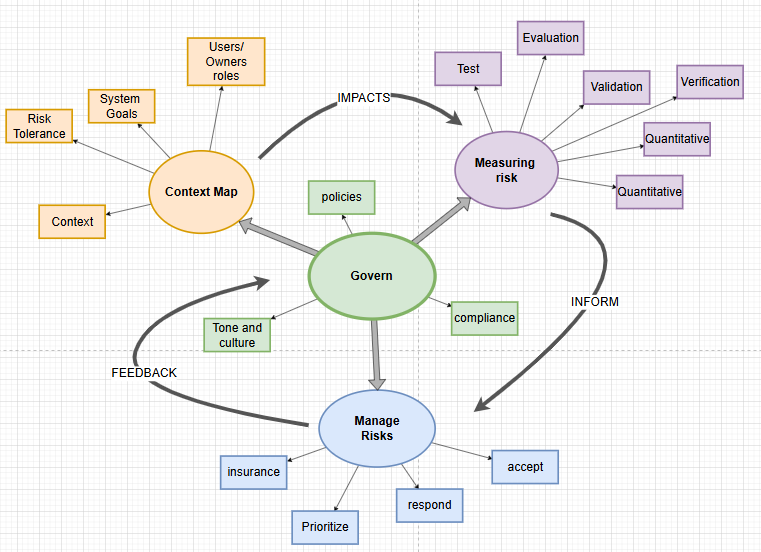
Done right, you get a continuous improvement cycle instead of a “set it and forget it” disaster waiting to happen. Trust isn’t a feature at the end—it’s the thing that lets you scale without fear of making headlines for all the wrong reasons.
If you’re ready to level up your AI solution and avoid being a cautionary tale, drop us a line. We’ve been there, fixed gaps, and would rather help you do it right the first time.